⏱ Estimated reading time: 12 minutes
If you’ve ever Googled what to do to improve your sleep, sleep hygiene will have come up. Repeatedly. But what even is it? And does it actually help?
It’s a term that’s been around since the 1970s, yet no-one can completely agree on a definition. Despite this, the internet is full of advice about it, and many people end up feeling like they’re “bad” at it. Some even feel worse about their sleep because of it.
Which is ironic, because sleep hygiene was never meant to be a rigid rulebook.
What is sleep hygiene?
Broadly speaking, sleep hygiene is a set of lifestyle and behavioural factors that support good sleep. Over the decades it’s been defined in various different ways, but the core idea hasn’t changed: the habits and conditions that give you the best chance of sleeping well.
What has changed is how sleep hygiene is used. Originally, sleep hygiene advice was meant to be tailored to the individual. Over time, that personalised approach has been replaced by a standardised checklist that gets handed to everyone, regardless of biology, lifestyle, or context 1.
In this guide, I’m stripping sleep hygiene back to what the research actually supports, and busting some myths along the way. Then you can decide what’s most likely to work for you. And if you need a bit more structure to make those changes, download my free Sleep Sheet to help you figure out what to prioritise.
How helpful is sleep hygiene?
Improving sleep hygiene will improve your sleep, right? Unfortunately it’s not that simple.
Some studies have found no connection between sleep hygiene awareness and sleep quality 2. Others have even found a negative link, where knowledge of sleep hygiene was associated with poorer sleep 2.
How can we make sense of this? Well, people who tend to struggle with sleep, also tend to try harder. And trying harder is not something that leads to good sleep.
Ask a “good” sleeper about their sleep hygiene and you’ll probably just get a confused look in response. Good sleepers don’t try to sleep. It comes naturally 3. They’re probably already doing lots of things right without even realising it. And that’s important – sleep should not be effortful.
In fact, the more effort you’re putting in, the greater the likelihood is that you’ll be struggling. People with insomnia tend to have elaborate bedtime routines, and a long list of things they “need” to help them sleep. The more they try, the harder it is for them to achieve their goal of “good” sleep.
So let’s be clear from the outset. These are not rules. They are not requirements. If trying to follow sleep hygiene advice increases pressure or anxiety around sleep for you, it is very unlikely to help.
I’m not about to tell you to stop doing everything you enjoy. If you love an afternoon espresso or watching Netflix in bed, read on to find out how this may (or may not) be impacting your sleep, and then make some informed decisions about what to change.
Common sleep hygiene advice
“Go to bed at the same time every night”
This is potentially great advice because sleep thrives on consistency. Consistent sleep timings allow your sleep drive to build steadily throughout the day, making it easier to fall asleep at night.
The main problem with this advice is that we can’t easily control what time we fall asleep.
It can be easier instead, to “anchor” your circadian rhythm to your wake time. Occasional lie-ins are fine. Large swings every weekend are less helpful.
What to do instead
- “Anchor” your sleep to a consistent wake-up time
- Keep lie-ins to within about an hour of your usual wake time
- Go to bed when sleepy, at roughly the same time most nights
“Don’t nap”
Based on what I’ve already said about sleep drive, you might be thinking this is good advice. Daytime sleep can reduce your sleep drive, making it harder to fall asleep at night – a bit like the way snacking before dinner can spoil your appetite.
The media also like to remind us that napping is linked to a long list of negative health outcomes, including depression, diabetes, and cardiovascular disease (4). This can sound alarming, but direction of causality matters. Naps don’t necessarily cause these things. People who are unwell often nap more because they need more sleep.
And there are benefits to napping. Naps can actually improve cognitive performance when we’re tired or sleep deprived 5.
For people who can’t get enough sleep overnight (e.g. shift workers, new mums), naps can increase total sleep time, leaving them less sleep deprived 6. In fact, in many cultures, napping is normal and considered healthy 5.
What to do instead
- Aim to meet your sleep needs overnight where possible
- Keep naps brief, ideally under 30 minutes
- Nap earlier in the day, not close to bedtime
“Avoid blue light at night”
Light is one of the strongest signals to our circadian rhythm, telling our bodies it’s time to be awake. Theoretically, this is why blue light at night is “bad”. Except that, for most of us, the blue light from our screens just isn’t strong enough to have an impact. Unless, that is, you’ve been in a dark room all day. That’s because our sensitivity to blue light increases if we haven’t been exposed to daylight during the day 7.
What to do instead
- Think in terms of a 24-hour “light diet”
- Get daylight exposure early in the day
“Don’t eat dinner late”
Assuming you eat a generally healthy diet, sleep is affected less by what you eat and more by when you eat. Eating late, or going to bed hungry or very full can disrupt sleep 2. Apart from the physical discomfort, sleep is more likely to be disrupted when our body is still busy metabolising food.
If you’re a late night snacker, you might find it easier to focus on breakfast habits. Eating breakfast helps to set our circadian rhythm so that we feel alert during the day, and sleepy at night 8.
What to do instead
- Avoid heavy meals close to bedtime
- Don’t go to bed hungry
- Don’t skip breakfast
You can find out more about the link between sleep and eating here.
“Avoid caffeine”
If you love coffee as much as I do this is an important one to understand. You may not need to give up caffeine entirely, or stop drinking coffee after 10am. The key is to understand your own individual response to caffeine and work with that.
Caffeine blocks adenosine, the chemical that builds sleep pressure while we’re awake. That can make it harder to fall asleep and can impact our sleep quality. And caffeine can remain active in the brain for up to eight hours 9.
However, there are huge individual differences in caffeine sensitivity and metabolism, partly driven by genetics 1. There’s also huge variability in how much caffeine is in different styles of coffee.
An espresso is not equivalent to a filter coffee. And a 9am espresso is not equivalent to a 3pm espresso.
What to do instead
- Work out your personal tolerance
- Pay attention to timing and quantity
- Consider decaf alternatives – honestly there are some good ones!
“Avoid alcohol”
People often think alcohol helps them sleep, and that’s because it can help us fall asleep faster. Unfortunately, it reliably disrupts sleep quality through dehydration and metabolic effects. And the closer to bedtime we consume alcohol, the greater the negative impact on our sleep 2.
Unfortunately, for most of us, close to bedtime is exactly when we’re consuming alcohol. And I’m not about to recommend day drinking as an alternative.
What to do instead
- Make your last drink of the night a non-alcoholic one
- Stay hydrated throughout the evening with non-alcoholic drinks
“Don’t exercise late at night”
This advice is based on the fact that exercise raises core body temperature. That’s usually bad news for sleep because our bodies naturally start to cool as we fall asleep. Raising our body temperature before bed can make it harder to fall asleep.
But as with all of this advice, there’s a lot of individual variation 10. For example, later exercise is less disruptive to your sleep if you’re a night owl than if you’re a morning lark (check your chronotype here if you’re not sure if you’re an owl or a lark).
Research also shows that moderate exercise up to four hours before bedtime is fine for most people. Whereas more intense exercise tends to be better earlier in the day.
Overall, regular exercise is very good for sleep. So finding a routine you enjoy and will stick to is important 2.
What to do instead
- Exercise regularly
- Choose activities you enjoy
- Avoid timing that clearly disrupts your sleep
“Have a relaxing bedtime routine”
Sounds helpful, but what constitutes “relaxing”? The good news is that we don’t all need to take up mindfulness or do breathing exercises in order to sleep well. In fact, no specific routine consistently improves sleep, because what we find relaxing is totally subjective.
Consistency helps, but routines work best when they’re flexible (because you can adapt them) and enjoyable (because you’re more likely to do them).
Rigid schedules that reflect effort and pressure to sleep can also backfire and lead to poorer sleep 3.
What to do instead
- Keep routines consistent but flexible
- Personalise what relaxation means for you
“Make your bedroom calm, quiet and dark”
Temperature, noise, light, and comfort all matter, but individual differences are significant 2. Some people wake with very small amounts of noise or light, others could stay asleep in a nightclub.
It’s also not possible for everyone to create their “perfect” sleep sanctuary – Maybe you live in a noisy neighbourhood for example, or have a partner who likes to read in bed with the light on. These things are only problematic if they are genuinely impacting your sleep.
Clock watching also deserves a mention here. Monitoring the time rarely helps us fall asleep more easily – in fact it’s way more likely to increase stress, which keeps us awake 2.
What to do instead
- Keep the bedroom cool and use bedding you can easily adjust
- Reduce or mask noise and light if they are disruptive
- Turn the clock around if you’re prone to clock watching
“Avoid screens before bed”
I’ve already busted the blue light myth, but if blue light isn’t the main problem with screens, what is?
For most people, the issue is displacement. Screens are engaging and make it easy to push bedtime later. They interfere with sleep by delaying it, not by directly disrupting sleep biology. People who use screens in bed are way more likely to stay up past their intended bedtime.
Screens aren’t universally bad though. They can help us relax, and can help us manage feelings of stress and loneliness, which can ultimately help with sleep 3.
What to do instead
- Have a screen curfew so your screen doesn’t push bedtime later
- Disable autoplay features so you don’t stay up bingeing your favourite show
Making changes that last
If you’re keen to improve your sleep hygiene, it’s important to remember that you don’t need to change everything at once. Making a small number of changes that fit your life, means you’ll be more likely to stick to your new habits.
Prescriptive rules backfire. People don’t stick to them, and resentment towards sleep builds. So be flexible and test a few things out.
It’s also important to say clearly that improving sleep hygiene won’t always fix sleep problems. People with chronic insomnia or other sleep disorders often need additional specialist support. Sleep hygiene can help, but it is not a panacea.
If you’re keen to get started and would like some free resources to help you, check out these downloadable freebies I’ve created.
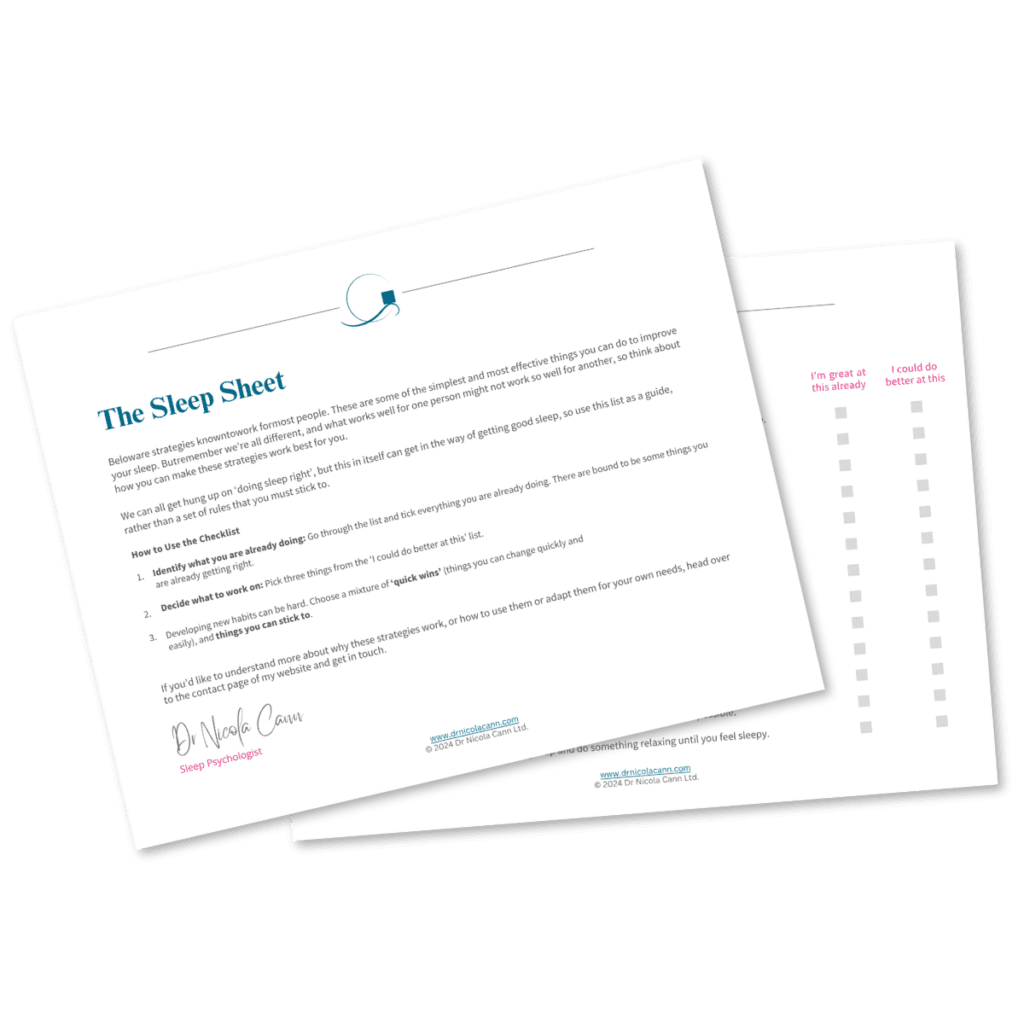
The Sleep Sheet is a checklist of evidence-based recommendations for improving sleep. Use the checklist to decide what to work on and start improving your sleep habits today.
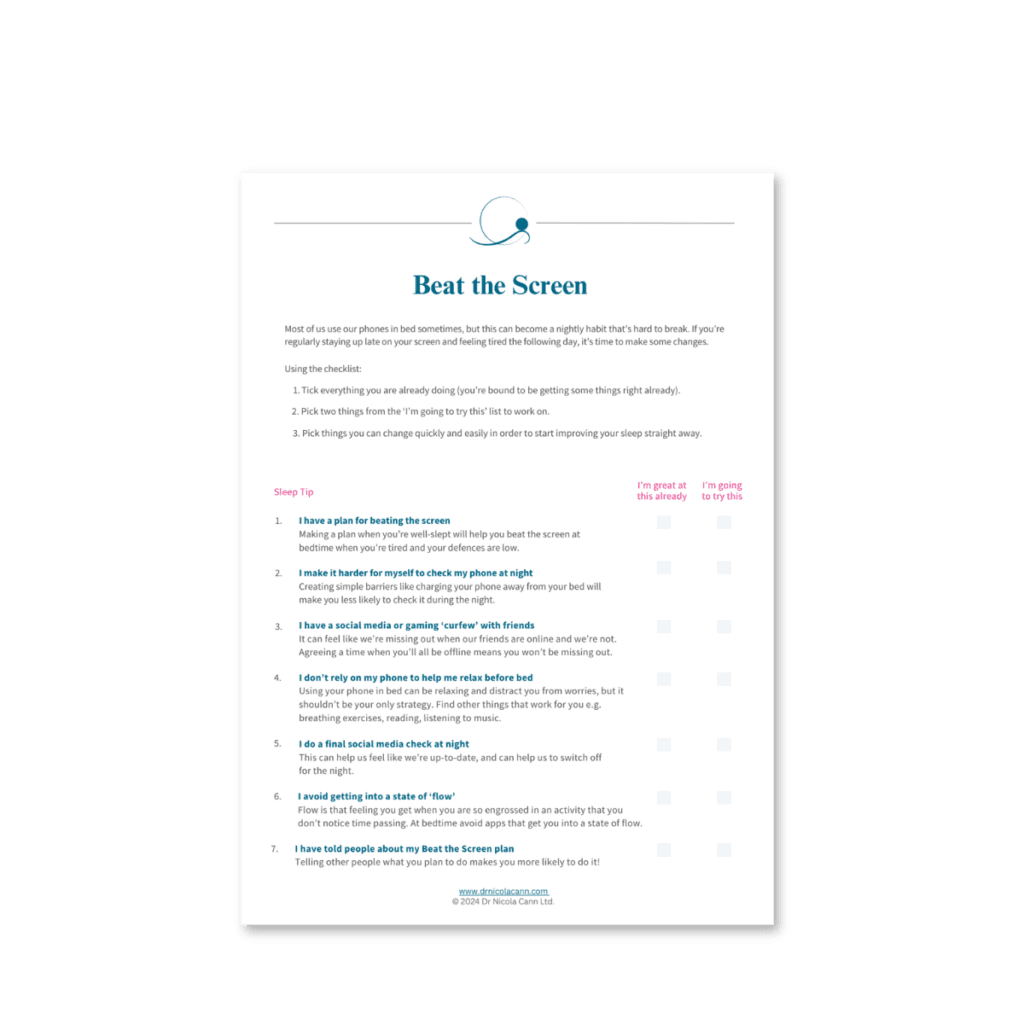
Worried that screen time is impacting your sleep? Download my Beat the Screen checklist to start getting your screen habits under control.
References
- Irish, L. A., Kline, C. E., Gunn, H. E., Buysse, D. J., & Hall, M. H. (2015). The role of sleep hygiene in promoting public health: A review of empirical evidence. Sleep medicine reviews, 22, 23-36.
- Ellis, J. G., & Allen, S. F. (2019). Sleep hygiene and the prevention of chronic insomnia. In Sleep and health (pp. 137-145). Academic Press.
- Meneo, D., Curati, S., Russo, P. M., Martoni, M., Gelfo, F., & Baglioni, C. (2024). A Comprehensive Assessment of Bedtime Routines and Strategies to Aid Sleep Onset in College Students: A Web-Based Survey. Clocks & Sleep, 6(3), 468-487.
- Mantua, J., & Spencer, R. M. (2017). Exploring the nap paradox: are mid-day sleep bouts a friend or foe?. Sleep medicine, 37, 88-97.
- Leong, R. L., Lo, J. C., & Chee, M. W. (2022). Systematic review and meta-analyses on the effects of afternoon napping on cognition. Sleep medicine reviews, 65, 101666.
- Mograss, M., Abi‐Jaoude, J., Frimpong, E., Chalati, D., Moretto, U., Tarelli, L., … & Dang‐Vu, T. T. (2022). The effects of napping on night‐time sleep in healthy young adults. Journal of sleep research, 31(5), e13578.
- Chang, A. M., Aeschbach, D., Duffy, J. F., & Czeisler, C. A. (2015). Evening use of light-emitting eReaders negatively affects sleep, circadian timing, and next-morning alertness. Proceedings of the National Academy of Sciences, 112(4), 1232-1237.
- Faris, M. E., Vitiello, M. V., Abdelrahim, D. N., Cheikh Ismail, L., Jahrami, H. A., Khaleel, S., … & Bahammam, A. S. (2022). Eating habits are associated with subjective sleep quality outcomes among university students: findings of a cross-sectional study. Sleep and Breathing, 26(3), 1365-1376.
- Gardiner, C. L., Weakley, J., Burke, L. M., Fernandez, F., Johnston, R. D., Leota, J., … & Halson, S. L. (2025). Dose and timing effects of caffeine on subsequent sleep: a randomized clinical crossover trial. Sleep, 48(4), zsae230.
- Facer-Childs, E., & Brandstaetter, R. (2015). The impact of circadian phenotype and time since awakening on diurnal performance in athletes. Current biology, 25(4), 518-522.