
⏱ Estimated reading time: 11 minutes
If you’ve ever felt wide awake at midnight but barely functional the next morning, struggled to fall asleep even though you were exhausted, or wondered why weekends seem to undo your sleep completely, it’s probably not a discipline problem. It is a timing problem.
Your circadian rhythm is your body’s internal clock, and it quietly controls when you feel sleepy and when you feel alert, as well as controlling lots of other daily rhythms in your body.
Most people think sleep is about getting enough hours. In reality, when you sleep matters just as much as how long. You cannot force your brain to sleep on command if your internal clock is saying “not yet”.
Understanding circadian rhythm explains why some sleep advice works beautifully for one person and fails miserably for another, why night owls exist, and why modern life so easily knocks sleep off track.
So if you’re struggling with sleep, or just want to feel more energised during the day, it could be time to consider the role of your circadian rhythm.
In this article I’ll help you to understand your own unique circadian rhythm, and share evidence-based tips for improving your sleep by strengthening your circadian rhythm.
So what is circadian rhythm?
Your circadian rhythm is a roughly 24-hour biological timing system that runs in the background of your brain and body.
We usually think immediately of sleep when we hear the phrase “circadian rhythm”, but our circadian rhythm is actually involved in so much more than just sleep.
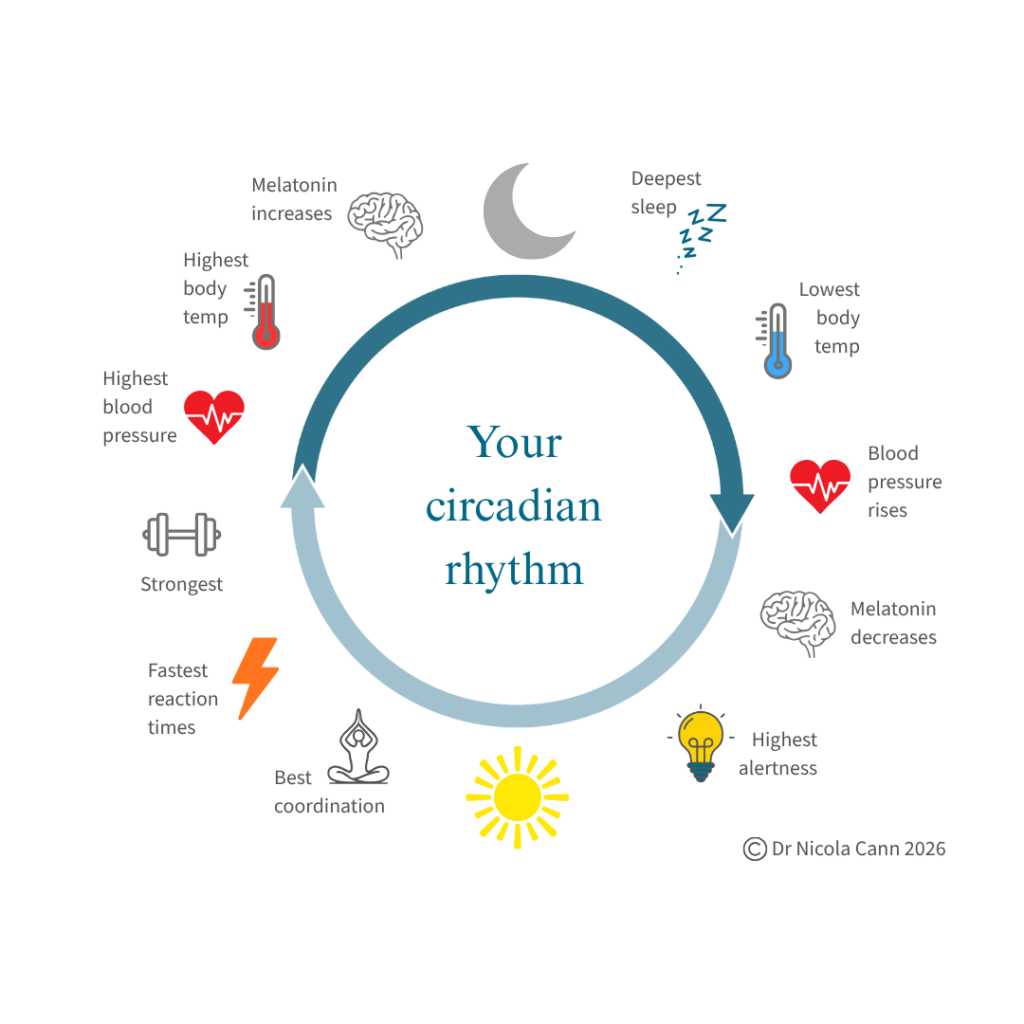
It influences when you feel alert or foggy, when hormones are released, when body temperature rises or falls, how your metabolism works, how resilient your mood is across the day, and many more physiological rhythms.
Circadian rhythms are also not uniquely human. They exist in animals, plants, fungi, and even bacteria. What makes them impressive is that they are internally generated. Even in total darkness, without clocks or daylight, the body continues to cycle through sleepiness and alertness on an approximately 24‑hour schedule 1.
Why circadian rhythm matters so much
Circadian rhythms get most of the attention in sleep discussions because when your body clock is out of sync, sleep is usually the first thing to fall apart.
When your sleep timing is aligned with your circadian rhythm, sleep tends to be:
- Easier to fall into
- More continuous
- More refreshing
- Better matched to daytime energy and mood
When our sleep is out of sync with our circadian rhythm we feel exhausted when we need to be awake, and wide awake when we want to be asleep.
In the longer-term, circadian misalignment has been linked to metabolic problems, cardiovascular disease, immune dysfunction, and mental health difficulties. So it’s worth paying attention to your circadian rhythm, and doing what you can to optimise your circadian health, for the benefits to your sleep and your long term health.
The science behind circadian rhythm: Meet the orchestra conductor
Does circadian rhythm vary?
Although we often talk about it as a 24‑hour clock, not everyone’s rhythm is identical. The timing and length of circadian rhythm is something that is unique to us as individuals.
This explains why some people leap out of bed at 6am but are exhausted by 9pm, and others want to lie in until 10am and could easily stay up until past midnight.
On average, women tend to have slightly shorter circadian rhythms and are more morning‑leaning, while men tend to have slightly longer rhythms and skew later.
Circadian rhythm also changes across the lifespan.
- Children tend to naturally be morning larks, sleeping earlier and waking earlier.
- In adolescence our circadian rhythm shifts to around two hours later, meaning that teens feel sleepy later and struggle with early mornings – it’s not just laziness, it’s biology.
- As we age, the clock shifts earlier again and becomes less robust, making sleep more vulnerable to disruption. This is why older adults often wake during the night.
Knowing your rhythm: Morning larks, night owls, or somewhere in the middle
Some people naturally wake early and feel alert in the morning. Others feel more alive late at night. And a lot of us are somewhere in the middle. In sleep science jargon we call this your chronotype.
Chronotype reflects the unique timing of your circadian rhythm. A night owl’s circadian rhythm runs later, meaning their peak alertness and peak sleepiness occur later in the day. A morning lark’s circadian rhythm runs earlier, meaning they can face those tricky tasks at work before their morning coffee break.
30% of us are morning types 3
20% of us are evening types 3
50% are middle types 3
Chronotype has a strong genetic basis. It reflects the timing of your internal clock, not your motivation or willpower. So if you prefer to be starting work at 6am, or find your groove at the gym at 9pm, it’s probably to do with your chronotype.
The healthiest outcomes in terms of sleep come when our sleep timings are aligned with our chronotype. Knowing your chronotype can help you to adjust your daily schedule to be more in time with your unique circadian rhythm.
If you’re not sure what your chronotype is you can get an indication by completing the Morningness-Eveningness Questionnaire 4 – This is a short, free, research validated questionnaire that can give you a sense of your individual circadian preference. Find it here.
When your circadian rhythm is out of sync
When our circadian rhythm is misaligned with our lifestyle, sleep is often the first thing to suffer. This is when we find ourselves feeling sleepy when we need to be awake, or wide awake when we need to be asleep. In fact, if our circadian rhythm is misaligned this can happen even if we’re getting the right amount of sleep 5.
This is why it’s so important to consider the timing of your sleep, as well as how much sleep you’re getting.
Unfortunately we can’t all live by our circadian rhythms. Life gets in the way of that. We have jobs that require us to be at our desk when we’d rather be in bed, or the only time we can exercise is in the evening when we’d rather be winding down for the evening.
Some of the most common causes of circadian misalignment include:
- Shift work or rotating work schedules
- Frequent international travel and jet lag
- Certain medications
It’s also important to recognise that some people have specific circadian rhythm sleep disorders, such as delayed sleep phase, where sleep onset happens very late and waking early feels impossible. When circadian misalignment is caused by a sleep disorder, rather than environmental or lifestyle factors, it’s important to seek specialist help.
So how do you keep your circadian rhythm aligned when your work or personal life doesn’t allow for that?
Keeping your clock in sync
You can’t completely change your chronotype, but the good news is that you can nudge it so that it’s more aligned with your commitments.
In fact, we nudge our circadian rhythms every day without even trying. Most of us don’t have a circadian rhythm that fits neatly into the 24 hour day, so our bodies rely on external cues to keep us in sync. This process is called entrainment, and we can use it to maximise our circadian alignment, even when our alarm goes off two hours before we’re ready to wake up.
One of the most powerful cues that helps nudge our circadian rhythm and entrain it to our daily schedule is light. Morning light tells your brain it’s daytime and helps set your internal clock earlier by suppressing melatonin. As light levels fall in the evening, the SCN signals for melatonin to be released, increasing feelings of sleepiness.
Unfortunately, many of us spend most of the day indoors, under relatively dim light, then flood our evenings with artificial light. This stops our circadian rhythm from getting the strong signals it needs to stay on track, and leaves us out of sync with our circadian rhythms.
From a circadian perspective, that’s a bit like being in a perpetual state of jet lag.
Working with your circadian rhythm, not against it
How can you use this information to improve your sleep?
You don’t need to optimise your life around your circadian rhythm. Simply sending it clearer signals can help keep your sleep on track.
The most impactful things you can do to keep your circadian rhythm aligned are:
Know your chronotype and work with it
Where possible, schedule your day according to your chronotype. This is not just about sleep timing but also timing of daylight, meals, exercise, and work.
If you’re an early bird you might want to shift your gym session earlier in the evening so you can wind down more easily. If you’re a night owl maybe you could schedule that demanding work task to later in the morning when you’re more cognitively alert.
Keep a consistent wake-up time
You can be a bit flexible on this but consistency is key to circadian health, so aim to keep your wake-up time within an hour, even on weekends. And there’s a good reason to focus on waking time rather than bedtime – waking up at the same time every day will make it easier to fall asleep at the same time every night.
Get regular morning light exposure
Ideally first thing in the morning, and ideally outdoors. But ultimately any amount of morning daylight will help set your circadian rhythm to the day. If a morning walk isn’t possible maybe just drink your mid-morning coffee by the window.
Final thoughts
Understanding your circadian rhythm helps explain why timing is so important, and why forcing sleep backfires.
Working with your body clock is far more effective than fighting it, and leads to far more positive long-term health outcomes. Your circadian rhythm is not something to optimise perfectly. It is a system to support.
Circadian health is about consistency, not perfection. Take a moment to think about ways you can improve your circadian health.
Ultimately, for most of us, some simple changes to your daily routine can nudge our circadian rhythm into alignment. The short- and long-term benefits of these small changes can be huge.
Whilst the tips above will be helpful for the majority of people, if you’re experiencing a specific issue with your sleep and circadian rhythm, you might need more individualised or specific advice. If this is the case, please get in touch.
References
- Xin, Q., Yuan, R. K., Zitting, K. M., Wang, W., Purcell, S. M., Vujovic, N., … & Czeisler, C. A. (2022). Impact of chronic sleep restriction on sleep continuity, sleep structure, and neurobehavioral performance. Sleep, 45(7), zsac046.
- Schroeder, A. M., & Colwell, C. S. (2013). How to fix a broken clock. Trends in pharmacological sciences, 34(11), 605-619.
- Wei, N. S., & Praharaj, S. K. (2019). Chronotypes and its association with psychological morbidity and childhood parasomnias. Indian Journal of Psychiatry, 61(6), 598-604.
- Horne, J. A., & Östberg, O. (1976). A self-assessment questionnaire to determine morningness-eveningness in human circadian rhythms. International journal of chronobiology, 4(2), 97-110.
- Grimaldi, D., Carter, J. R., Van Cauter, E., & Leproult, R. (2016). Adverse impact of sleep restriction and circadian misalignment on autonomic function in healthy young adults. Hypertension, 68(1), 243-250.